





Facts vs Fables:
CRG Network Defends Report Against
Fabricated Attacks
Encore Report
Dr. Michael Rosen, President of American Federation of Teachers Local 212, has assailed the audit performed by CRG Network as filled with "outright lies and exaggerations." This encore report will separate the facts from Rosen's unsubstantiated fables (in the order they appear).
FABLE #1: The report is not a “forensic audit” as it claims. In fact, it is not an audit at all.
FACT: The word "forensic" appears only once in the report in reference to a forensic review of the salaries. Although the report NEVER characterized itself as a "forensic audit" (only the Milwaukee Journal Sentinel article did) it could have rightfully done so. The Institute of Forensic Auditors offers the following definition:
"Forensic audit is the activity that consists of gathering, verifying, processing, analyzing of and reporting on data in order to obtain facts and/or evidence - in a predefined context - in the area of legal/financial disputes and or irregularities (including fraud) and giving preventative advice."
FABLE #2: There is no original research. Most of the data was simply cut and pasted from earlier Milwaukee Journal Sentinel articles or Bruce Murphy’s columns.
FACT: CRG Network employed over 1000 pages of original MATC documents obtained through use of the state open record laws. A review of all major MATC union contracts was also conducted in preparing the report. The audit team included five Certified Public Accountants, two MBAs and an attorney. Mr. Rosen is invited to examine all of the requests, responses, and payments made by CRG Network to obtain these records. The audit team is listed in the report.
FABLE #3: CRG ... has now morphed into a single issue Republican front group dedicated to undermining support for public institutions like MATC and hostile to all public employees.
FACT: CRG Network is an organization dealing with multiple issues: taxation, waste, property rights, and public corruption, to name a few. It has held both Democrats and Republicans accountable. In fact, it has successfully acted against higher-ranking Republicans as opposed to lower-ranking Democrats. While it is a matter of record that public employees may benefit from the largesse of incompetent and corrupt public officials as they did in the Milwaukee County pension scandal, CRG Network has reserved its actions for public officials and has never acted against a public employee or union.
FABLE #4: CRG states that all MATC faculty members receive double pay increases every year averaging 6% to 8% per year. This is a complete fabrication. More than 60% of the faculty only received a modest 2.85% increase over each of the last three years.
FACT: The audit did not say ALL employees received the increases, it merely stated the terms of the current contract. A faculty member employed at a labor step of 0 will, for the next 14 years regardless of competence or merit (but simply by completing one year of employment), receive both a cost of living and a labor step increase in the subsequent year (Source: Labor contracts 2003/06: Paraprofessional p. 23-29; Part-time faculty p. 21, 50-52; Full-time faculty p. 56, 89-91).
In a November 16, 2003 Journal Sentinel article entitled “Costs put squeeze on budgets”, Dr. Darnell Cole, MATC president, states that the average MATC salary is high. He pointed to a survey by the Chronicle of Higher Education showing that the average instructor at a two-year college was paid slightly less than $52,000, compared with about $72,000 at MATC.
CRG network auditors question how the average MATC instructor’s salary can rise from $72,000 (per Dr. Cole) in 2003 to $90,850 in 2005-06, an increase of 26% over 3 years, based on Rosen's claim. The average faculty member must have received annual salary increases of close to 8% to account for a 26%, 3-year increase.
Furthermore, consider the following wage increases for several of the highest paid MATC faculty members.
| Name | 2001/2 Salary | 2005/6 Salary | Total Increase | Ave 4-Yr Increase |
| Louis A Giacinti | $99,720 | $134,111 | 34.5% | 7.7% |
| Patricia D Kielpinski | $98,914 | $140,229 | 41.8% | 9.1% |
| Kevin C Mulvenna | $111,728 | $144,603 | 29.4% | 6.6% |
| Robert E. Transon | $94,516 | $145,731 | 54.1% | 11.4% |
| Linda L. Zizzo | $103,549 | $133,960 | 29.3% | 6.6% |
It is a simple matter to look at total salaries for all MATC faculty over the last three years and compute the average salary. Whether wage increases are going to one MATC faculty member or being spread equally (clearly it is not, several favored persons appear to be receiving a lion's share of the increases) the fact remains that salaries are increasing far above inflation and, in particular, above the taxpayer's capacity to pay.
FABLE #5: CRG states that retiring employees can cash in or use for retiree health care 150 sick days. This is another outright lie. Only 48 days can be cashed or used for health care and only if someone accumulates twice that number of sick days. The total amount that could be paid is therefore 1/3 of the amount CRG reported.
FACT: The Labor contract for full-time faculty 2003/06 page 62, 63, and 64 states: “One-half of unused accumulated sick leave, up to a maximum of forty-eight days (48) of full pay is to be used to continue the payment of health insurance premiums for the employee……at the time of his/her retirement. The employee has the option to request a lump sum payment equivalent to the total benefit less any payments made for the extended medical coverage.” “All full-time employees shall earn 15 days sick leave credit per year, with maximum accumulation of 150 days and with an unlimited accumulation of ½ day of sick leave for each accumulated full day over 150 days. We suggest that Rosen familiarize himself with his own contracts. The CRG Network report simply relayed the contract language.
FABLE #6: CRG states part-time faculty and staff get paid sick leave at retirement. The lies continue. There is no payment of sick days at retirement for any part-time employee.
FACT: The report states that full-time FACULTY and part-time/full-time PARAPROFESSIONAL employees receive pay for unused sick leave at retirement based on the provisions of the labor contracts. Nowhere does the report state that part-time FACULTY receive sick leave at retirement. Source: Collective bargaining agreements 2003-2006: Full/part-time paraprofessional pg. 43, Full-time/faculty pg. 62, 64, 65, 69. We suggest Mr. Rosen pay closer attention to what he reads.
FABLE #7: CRG states MATC faculty receive 8 sabbaticals a year. At least they are only half wrong here. The maximum number of sabbaticals is four in one year. Paraprofessional staff may get one sabbatical.
FACT: Mr. Rosen uses a clever semantic strategy here. Per union contract, “Sabbatical leave is limited to 4 teachers per semester.” The contract is purposely worded this way to allow for up to eight different faculty members to take six month sabbaticals in any given year. Technically, if the the same four teachers each took a one year sabbatical, only those four faculty members would be on sabbatical in a given year. The report goes on to clearly state this practice by citing that “20 sabbaticals since 2001/02 had taken place.” That equates to 4 per year.
This is another example of Rosen attempting to take the the focus off the real issue. Why is MATC allowing taxpayer funds to be used in this manner?
FABLE #8: CRG states MATC cost per FTE is $24,000 The truth, according to the Wisconsin Technical College system state office, is $12,000, the state average for tech colleges.
FACT: Rosen claims that the cost per FTE (Full-Time Equivalent student) at MATC is $12,000, and yet we have another set of numbers by MATC Chief Financial Officer Michael Sargent that places the cost at $17,619. CRG Network auditors settled the issue by reviewing the MATC 2006/2007 budget signed by Chairperson Jennette Bell and MATC President Dr. Darnell Cole, and reported in the May 24, 2006 Journal/Sentinel article “MATC seeks 5% increase in tax levy.” The total spending by MATC has increased from $233.4 million in 2000/01 to $309 million in 2006/07. MATC has approximately 13,000 full time equivalent students at the present time. The current level of spending at MATC of $309 million generates a total cost to educate each student attending MATC of $23,760, nearly the same as the full tuition at Marquette University.
Both the Rosen and Sargent figures leave out significant portions of total spending per student and are not only inaccurate but misleading.
FABLE #9: CRG states the average MATC faculty salary is $90,000. The truth is the range of faculty salaries is $44,002 to $85,156. Faculty who earn above that are teaching additional courses at a reduced part-time faculty salary rate or are being paid to do administrative work.
FACT: Mr. Rosen would lead the average citizen to believe that faculty earning above the contractually established pay range are putting in overtime to save taxpayer money. He conveniently neglects to mention that the same contract calls for fulltime faculty to work only 168 days per year (less after sick days) and only 32-hour weeks on top of that. The average non-MATC worker puts in over 240 days per year and 40-hour weeks (much more if you are salaried). No wonder MATC faculty has so much "extra time" to earn "extra pay." Mr. Rosen even admits that 60% of the faculty are at the top of their pay range.
What Milwaukee area worker would not just LOVE to make $85,156 to work just two-thirds of an average work year?
FABLE #10: The reason WTCS property taxes have increased is because the State of Wisconsin under Republican leadership has reneged on its commitment to provide tech colleges with one third of their funding.
 FACT:
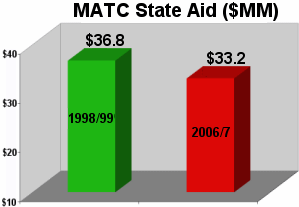
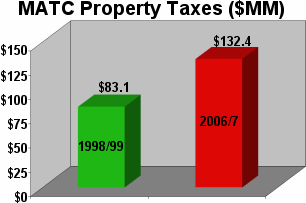
With all due respect, state funding over the last eight
years has been reduced by a paltry $3.6 million while the MATC
property tax levy has increased $49.3 million and total MATC
spending has increased $102 million (about 50%). The
shortfall is clearly due to MATC spending far outstripping the
ability of taxpayers to keep up, through either state sales and income
taxes (where the majority of state revenue is derived) or
property taxes. A large portion of that is
salary and benefits.
FACT:
With all due respect, state funding over the last eight
years has been reduced by a paltry $3.6 million while the MATC
property tax levy has increased $49.3 million and total MATC
spending has increased $102 million (about 50%). The
shortfall is clearly due to MATC spending far outstripping the
ability of taxpayers to keep up, through either state sales and income
taxes (where the majority of state revenue is derived) or
property taxes. A large portion of that is
salary and benefits.
FABLE #11: And what does CRG propose? DOUBLING MATC TUITION! This would make MATC more expensive than most four year UW Universities and all two year UW colleges.
 FACT:
Leave it to a economics professor to turn the equation
upside-down. The CRG Network proposal was a market
driven solution designed to drive down MATC costs, not drive up
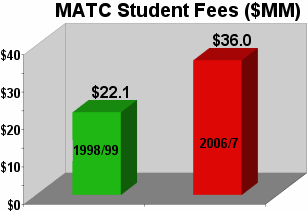
student fees and tuition. In fact, it is MATC that has
increased student fees over the last eight years by over 60%!
The proposal explicitly stated that ONLY non-technical courses
should be required to meet the UW System standard for
percentage of costs covered by tuition in order to create cost
competition between two taxpayer funded educational systems
providing identical services. This would force MATC to
reduce its costs or lose its customers to the more cost
efficient UW System.
FACT:
Leave it to a economics professor to turn the equation
upside-down. The CRG Network proposal was a market
driven solution designed to drive down MATC costs, not drive up
student fees and tuition. In fact, it is MATC that has
increased student fees over the last eight years by over 60%!
The proposal explicitly stated that ONLY non-technical courses
should be required to meet the UW System standard for
percentage of costs covered by tuition in order to create cost
competition between two taxpayer funded educational systems
providing identical services. This would force MATC to
reduce its costs or lose its customers to the more cost
efficient UW System.
With regard to so-called customer satisfaction surveys Mr. Rosen keeps referring to, the next installment of this report will provide first-hand accounts from students, former faculty members, administrators, and public officials about the skeletons buried deep within MATC.
Conclusion
Mr. Rosen misses the point of the CRG Network report. We are not looking to pick a fight with the unions. We completely respect the right of workers to organize and work zealously to maximize their return. That is the function of a union, and CRG Network routinely praises union workers as model "Good Americans." In fact, we forwarded a copy of a slide from our standard presentation to Mr. Rosen that explicitly says so. It can be reviewed HERE
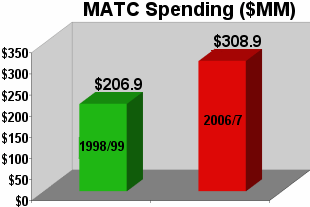
Unfortunately, Mr. Rosen has chosen to characterize the CRG Network report as an attack on unions versus a statement about the failure of the unelected MATC board to meet its fiduciary responsibility to the taxpayers. The real fact is that MATC total spending has increased from $206.9 million in 98/99 to $308.9 million in 2006/07. Spending has increased 3 times faster than the growth in both the CPI and Greater Milwaukee Area per capita incomes since 1991. Mr. Rosen, who is an economics instructor, is aware that this level of spending is NOT sustainable. In fact, the MATC students that Mr. Rosen pretends to be financially concerned about, have seen tuition and fee increases of 64% over the past 8 years. State funding has declined from $36.8 million to $33.2 million over this same period, but whether funding for MATC comes from the property taxpayer, income taxpayer, or student, one conclusion is perfectly clear - overspending ultimately HURTS education by making it unaffordable for the students and taxpayers alike.
Unions deserve to get whatever they bargain for and taxpayers expect their representatives to bargain just as dutifully on their behalf. Sadly, that has not happened. However, when groups or persons choose to make unsupported and specious claims about the integrity of CRG Network, its members, and its work product, we must, and will, respond forcefully.
CRG Network is fully cognizant that our report will weaken Mr. Rosen's future bargaining position and strengthen the competitive position of taxpayers. He is doing his job and we are doing ours. Perhaps it is simply because Mr. Rosen has had no competition in the past that he reacts so wildly to the fact that another team has finally taken the field to challenge him. Let's play ball!
Copyright 2006, CRG Network